Dentistry has always grown in tandem with technology. But the next leap? It’s to a world where microrobots can brush your teeth, autonomous systems can perform precise crown preparations, and remote-controlled tools extend expert care to every corner of the UK.
What’s becoming possible? And what is just around the corner?
Imaging deploying a swarm of tiny robots that can easily access difficult-to-reach areas to provide treatment, as well as collect samples for diagnostics. It sounds like science fiction, but researchers at Penn Dental Medicine have demonstrated just that: iron-oxide nanoparticle microrobots that assemble into bristles to remove plaque, then reshape as floss, and even retrieve biofilm samples for microbiological analysis1.
In one proof-of-concept study published in the Journal of Dental Research, these microrobots accessed narrow root-canal spaces to disrupt biofilms and deliver targeted therapies2, an innovation that could transform endodontic treatment.
Fully Autonomous Procedures
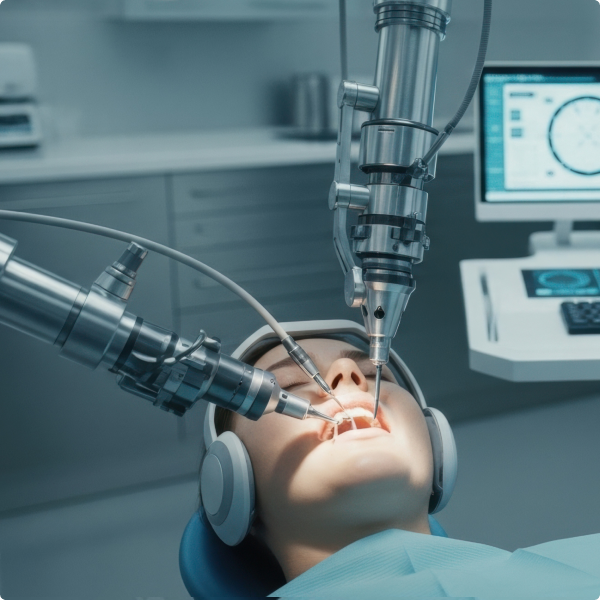
Could a robot ever perform a crown preparation? In 2024, a US-based system called Perceptive reportedly pulled off the world’s first fully autonomous tooth-prep procedure in under 15 minutes3, that’s faster than the average human workflow. While a full medical peer-reviewed publication is still pending, the case signals where the field is heading.
If regulatory clearance is achieved, such systems may one day support care delivery in rural, underserved, or high-demand environments, expanding access and maximising precision.
Haptic Teleoperation: Real Remote Care
Remote treatment has been an appealing vision for decades, with the COVID-19 pandemic reinforcing how important this technology could be – there may now be technology to push remote appointments beyond initial consultation.
Though still in its early stages, a 2025 study detailed the possibility of a haptic bilateral teleoperation system that translates a clinician’s movements and touch over a robotic arm during free-hand tasks like scaling. The force feedback used would ensure accuracy, safety, and procedural finesse even from afar4.
Imagine expert hygienists or endodontists guiding treatments across distance, but still with real-time tactile control. Could this be the future of specialist outreach?
What Could This Mean For Your Practice?
Robotics in dentistry is still in its infancy, but in the future, robotic innovations like these could be key to your practice. What will change?
- Greater accuracy and predictability: Robotic systems are designed to enhance precision. As this technology matures it will support you in performing higher-quality care with less variability.
- Relief for busy dental teams: Robotics may offer a practical way to lighten the load caused by staff and skill shortages.
- Comprehensive reach: Teleoperated robotics is already being tested for remote treatment delivery, which will help support underserved rural communities, and enable collaboration with off-site specialists.
By embracing robotics and related digital tools early, you’ll be creating a practice that’s ready for what’s next. Whether it’s integrating AI diagnostics or fully digital workflows, you can lay the groundwork today to make your practice ready for tomorrow.
)
Digital Equipment
Elevate Your Practice with Same-Day Dentistry: Intraoral Scanning, Chairside Milling and 3D Printing