Back
Back












- Back
- Rewards


From demographics and patient demands, to technique and philosophy, and even our overall understanding of oral health – dentistry is constantly evolving. And these changes need new and innovative dental materials, including adhesives.
Meeting Modern Standards…
Manufacturers continue to make improvements to dental adhesives to meet clinicians’ modern needs. Universal adhesives in particular offer important advantages in performance and ease of use. A good universal adhesive should include the following characteristics:
- High bond strength.
- Compatibility with your preferred etching technique.
- Suitability for direct and indirect restorations.
- Ability to bond to restoration materials like glass ceramic, zirconia, metals, and composite without extra primer.
Universal adhesives are compelling for these reasons alone, but there are actually five more performance benefits you may not have considered.
…And Exceeding Them
1. Radiopacity: Distinguish Adhesive Layers From Gaps, Voids, And Caries
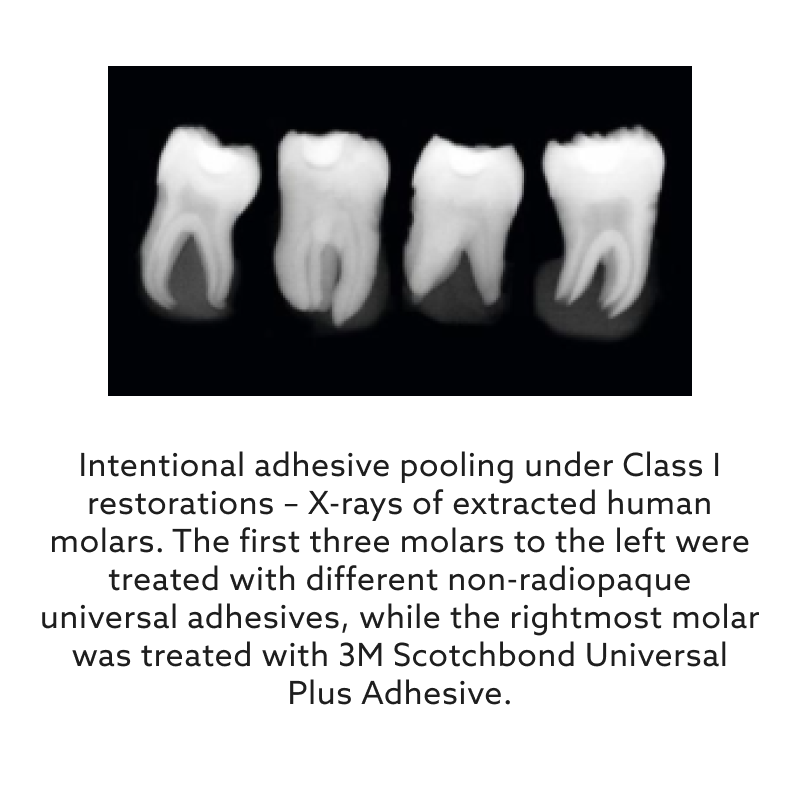
Most universal adhesives are radiolucent. On an X-ray, it can be difficult to differentiate between adhesive pooling, secondary caries, marginal gaps, and voids beneath the restoration, particularly in hard-to-inspect areas. Radiolucency under an existing restoration can lead to misdiagnosis – and potentially invasive overtreatment.
To remedy this issue, some manufacturers add inorganic radiopaque fillers to increase the adhesive’s radiopacity. However, inorganic fillers can increase the viscosity and affect the material’s application properties, making handling more challenging. Plus, fillers tend to settle over time, which can negatively impact the quality of the product if the bottle is not shaken thoroughly before use.
To avoid potential problems, look for a universal adhesive formulated to achieve dentine-like radiopacity without the addition of radiopaque fillers. 3M™ Scotchbond™ Universal Plus Adhesive, for example, uses a newly developed radiopaque monomer that remains homogeneously distributed in the adhesive and ensures low viscosity.
2. Adhesion To Caries-Affected Dentine: Support Minimally Invasive Procedures
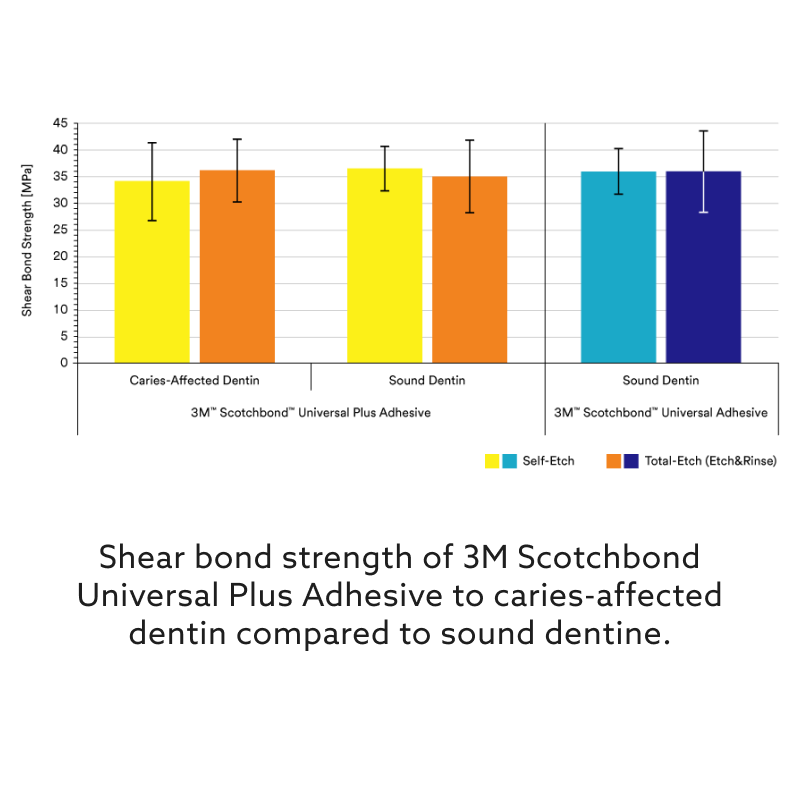
More and more dentists are utilising minimally invasive approaches and are looking for ways to preserve as much natural tooth structure as possible when removing caries. In most cases, this means leaving caries-affected, but firm, dentine in place on the cavity floor. And in deep cavities, even the soft dentine close to the pulp can be left near the pulp. However, to make this approach successful, there needs to be a tight seal around the carious tissue. The seal cuts off the remaining bacteria from their nutrient supply and stops tooth decay from progressing.
Thankfully, you can maintain your commitment to minimally invasive restorations and still use a universal adhesive. 3M Scotchbond Universal Plus Adhesive, for example, has been formulated for a strong bond to both sound and caries-affected dentine, as well as seal caries-affected dentine by forming a clearly defined continuous hybrid layer. This means clinicians can take advantage of the universal adhesive’s physical properties and workflow benefits while preventing secondary decay.
3. BPA-Derivative-Free Formulation: Alleviate Patient Concerns
Spurred by the increasing discussion around Bisphenol A in various media, patients and dentists are looking for treatment options that do not involve formulations based on BPA derivatives, like BisGMA. To give your patients maximum confidence in the materials you use, seek out universal adhesives with a BPA-derivative-free formulation such as 3M Scotchbond Universal Plus Adhesive.
4. Function As A Primer For Indirect Restorations: Improve Durability, Streamline Procedure, And Reduce Inventory
Most dental professionals are used to applying a primer (e.g. a silane) when bonding to indirect restoration materials. However, this step can be eliminated while improving bond strength with the right adhesive.
Usually, dental primers contain a coupling agent like silane, diluted with solvent. Silanes contain reactive groups that help promote a bond between organic and inorganic materials (i.e. the tooth structure and the restoration material). Silanes can be further enhanced by being paired with a variety of functional groups that improve compatibility with different polymers.
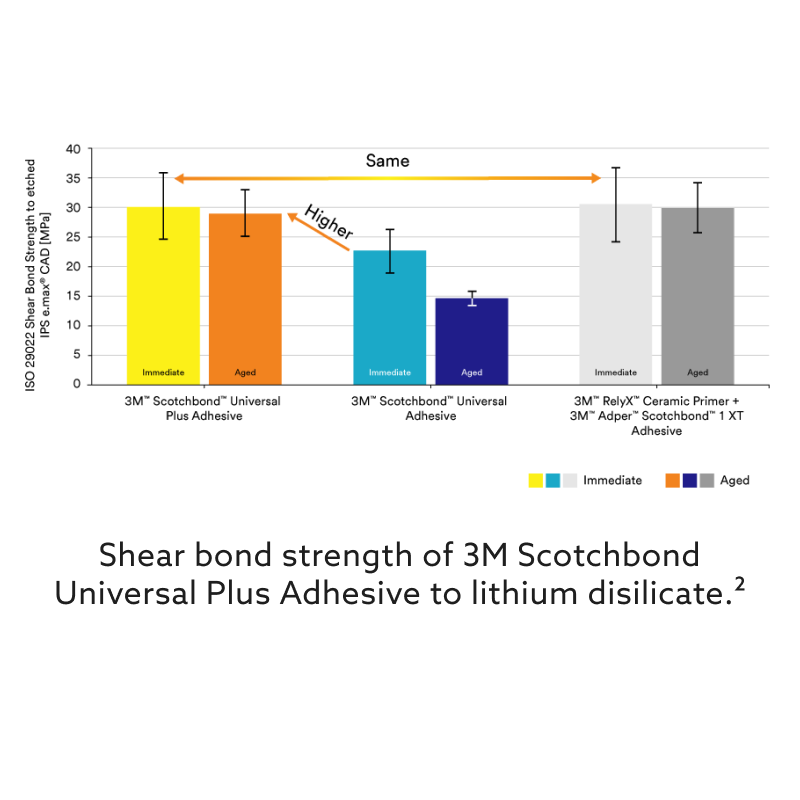
3M Scotchbond Universal Plus Adhesive contains an optimised mixture of silanes that enable it to function as both a primer and adhesive. In addition to the methacrylate-functional silanes present in its predecessor, 3M Scotchbond Universal Adhesive, the new formulation also contains amino functional silane. This combination provides gold standard bond strength to etched glass ceramic.
In fact, several in-vitro studies showed that the bond strength of Scotchbond Universal Plus Adhesive to etched glass ceramic is comparable to that of adhesives with a separate silane.
5. Self-Cure And Dual-Cure: Streamline Procedure, Reduce Inventory, And Improve Confidence
Acidic adhesive formulations like modern universal adhesives are often incompatible with the peroxide/amine initiators used in self-cure and dual-cure products, such as resin cements or core build-up materials, because the acidity can inhibit the cure at the interface to the adhesive.
To overcome this incompatibility, typically a so-called self-cure activator or dual-cure activator needs to be mixed with the adhesive as an extra step before application. 3M Scotchbond Universal Plus Adhesive contains a small amount of transition metal salt which provides peroxide/amine initiator compatibility and eliminates the need for a separate activator. However, the adhesive still needs to be polymerised with a curing light, in order to ensure maximum performance.
3M Scotchbond Universal Plus Adhesive has an additional benefit when used in combination with 3M RelyX Universal Resin Cement: the adhesive doesn’t need to be light cured because the self-curing mechanism of the resin cement also cures the adhesive layer. This means the adhesive can be optimally distributed by the pressure of restorative material placement – thereby avoiding any potential fit issues caused by pooled adhesive cured before placement of the restoration.
Universal adhesives offer many advantages and some materials have evolved well beyond a strong bond. These next-generation materials are formulated to address specific dentist needs, such as radiolucency or support for minimally invasive dentistry. For these reasons, it’s worth taking a fresh look at universal adhesives, and how the latest advancements could help you achieve your goals.

Dr. Christoph Thalacker has been part of 3M ESPE/3M Oral Care since August 2001. As the Head of Adhesives R&D, his focus is on adhesives and filling composites. In his spare time he likes hiking, cycling, skiing, languages, cooking, home improvement, and gardening.
References:
- 3M internal data: Interaction of an experimental universal adhesive with caries-affected dentin, C. Thalacker, H. Loll, B. Anich, K. Dede, J. Madden, A.S. Abuelyaman, B. Craig, J Dent Res 99 (Spec Iss A): No. 191, 2020
- Optimizing glass-ceramic bonding incorporating new silane technology in an experimental universal adhesive formulation, C. Yao, M.H. Ahmed, L. De Grave, K. Yoshihara, B. Mercelis, Y. Okazaki, K.L. Van Landuyt, C. Huang, B. Van Meerbeek, Dent. Mater. 2021, 37, 894-90