Back
Back













- Back
- Rewards


This blog explores the connection between oral health, mental wellbeing, and cognitive health, with a focus on emerging research into the oral microbiome and its possible role in brain health.

- Oral health is connected to whole-body health, with poor oral hygiene affecting eating, speaking, sleeping, confidence, and quality of life.
- Research suggests that oral health and brain health may influence each other, although more evidence is needed to confirm causation or clinical biomarkers.
- Mental health conditions such as depression, anxiety, dental phobia, and cognitive decline can make daily oral hygiene routines and dental appointments harder to maintain.
- Some conditions, such as eating disorders, and certain medications can increase oral health risks, including enamel erosion, poor nutrition, dry mouth, tooth decay, and gum problems.
- Studies suggest oral microbiota may play a role in the mouth-brain connection through microbial imbalance, inflammation, the bloodstream, and the oral-gut-brain axis.
- Emerging studies link oral microbiota with brain-related conditions such as dementia, Alzheimer’s disease, schizophrenia-related cognitive dysfunction, memory problems, and cognitive performance.
Key Takeaways:
- Oral health is connected to whole-body health, with poor oral hygiene affecting eating, speaking, sleeping, confidence, and quality of life.
- Research suggests that oral health and brain health may influence each other, although more evidence is needed to confirm causation or clinical biomarkers.
- Mental health conditions such as depression, anxiety, dental phobia, and cognitive decline can make daily oral hygiene routines and dental appointments harder to maintain.
- Some conditions, such as eating disorders, and certain medications can increase oral health risks, including enamel erosion, poor nutrition, dry mouth, tooth decay, and gum problems.
- Studies suggest oral microbiota may play a role in the mouth-brain connection through microbial imbalance, inflammation, the bloodstream, and the oral-gut-brain axis.
- Emerging studies link oral microbiota with brain-related conditions such as dementia, Alzheimer’s disease, schizophrenia-related cognitive dysfunction, memory problems, and cognitive performance.
Key Takeaways:
- Oral health is connected to whole-body health, with poor oral hygiene affecting eating, speaking, sleeping, confidence, and quality of life.
- Research suggests that oral health and brain health may influence each other, although more evidence is needed to confirm causation or clinical biomarkers.
- Mental health conditions such as depression, anxiety, dental phobia, and cognitive decline can make daily oral hygiene routines and dental appointments harder to maintain.
- Some conditions, such as eating disorders, and certain medications can increase oral health risks, including enamel erosion, poor nutrition, dry mouth, tooth decay, and gum problems.
- Studies suggest oral microbiota may play a role in the mouth-brain connection through microbial imbalance, inflammation, the bloodstream, and the oral-gut-brain axis.
- Emerging studies link oral microbiota with brain-related conditions such as dementia, Alzheimer’s disease, schizophrenia-related cognitive dysfunction, memory problems, and cognitive performance.
Over the years, many studies have been conducted that suggest oral health affects more than just your mouth – it can impact your entire body, in both physical and cognitive senses.
Poor oral hygiene can affect sufferers’ day-to-day lives in a variety of ways, from eating, speaking, and sleeping, to overall confidence. And while evidence points to a link between oral health and physical conditions such as diabetes, cardiovascular disease, rheumatoid arthritis, respiratory infections, and more,1 studies also suggest that its effect on mental and cognitive health may also be significant.
Understanding The Two-Way Link Between Oral Health, Mental Health, And Cognition
Poor mental and cognitive health can intertwine with poor oral health in a number of ways, often presenting as a cycle in which can lead to further decline if not broken:
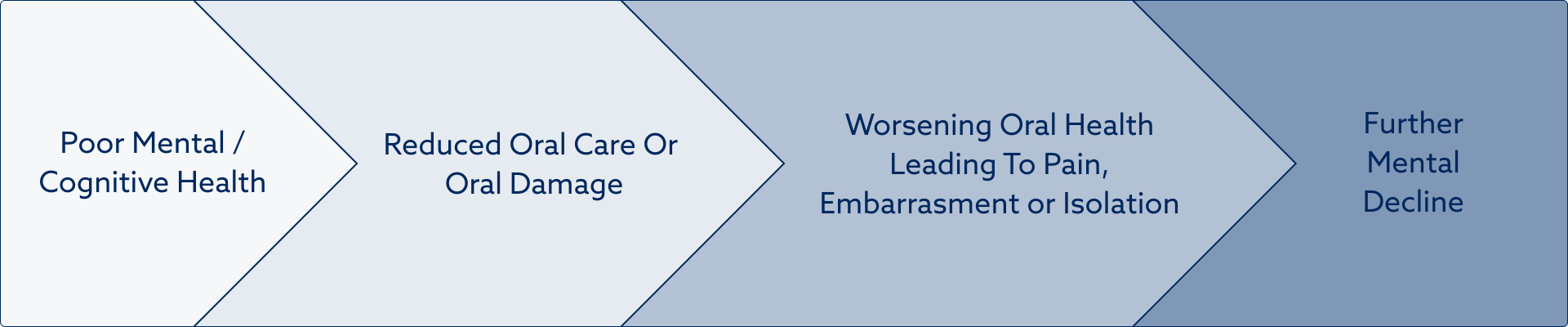
Mental health conditions such as depression can reduce the individual’s motivation to brush, floss, eat well, or seek care, while anxiety or dental phobia can lead to the avoidance of professional dental care entirely, and eating disorders can directly affect oral health through enamel erosion and poor nutrition. Separately, cognitive decline can make daily routines harder to maintain due to memory loss, declining motor functions, or reduced comprehension.
Furthermore, certain medications for such conditions can also increase the risk of tooth decay, gum problems, and oral discomfort, due to unpleasant side effects such as dry mouth.
But when we look deeper into the relationship between oral and mental/cognitive health, the following question arises: what role could oral microbiota play, if any?
The Role Of Oral Microbiota In Mental And Cognitive Health
We have known for some time that mental and cognitive health can impact oral health, but can oral health impact mental and cognitive health to the same degree?
Many researchers are now asking whether poor oral health, particularly changes in oral microbiota (the community or microorganisms that live in the mouth) may also contribute to the onset or progression of mental and cognitive conditions.
When the balance of oral microbiota is disrupted, harmful bacteria may increase, which in turn can contribute to inflammation and oral disease – and recent studies suggest that it could influence brain health too.

The Mouth To Brain Connection
According to the 2025 study on human oral microbiome and its influence on mental health and brain disorders by Alejandro Borrego-Ruiz and Juan J Borrego,2 while a substantial body of evidence suggests gut microbiota dysbiosis plays a role in the onset and progression of various mental disorders, research on the microbiota of other host-associated sites, such as the oral cavity, remains relatively underexplored in comparison. However, they suggest there are multiple pathways for the mouth and brain to connect.
- Bloodstream And Brain Health: Chronic oral diseases may impair the oral mucosal barrier, allowing microorganisms and endotoxins to enter the bloodstream, which may trigger systemic inflammation.
- Inflammation: If systemic inflammation is triggered, it may lead to neuroinflammation and cognitive dysfunction, and contribute to the onset and development of mental health conditions.
- Oral-Gut-Brain Axis: Oral bacteria are regularly swallowed and may interact with the gut microbiome. Because the gut-brain axis is already linked with mood and cognition research, oral microbiota may be part of this wider microbial network.
Other studies also support the notion that oral and brain health are connected, with deeper exploration into specific mental health conditions such as depression, anxiety, and schizophrenia, as well as cognitive conditions such as Alzheimer's and dementia.

Depression And Anxiety
Research has found that oral microbiota diversity may be significantly negatively correlated with depression, meaning that oral microbiota could potentially act as a future biomarker for mental health conditions, allowing earlier intervention and management of depressive disorders.
However, additional research is needed, as studies so far suggest that correlation can vary between race and gender, and that the association can change when the ecological balance of oral microbiota is disrupted.3

Alzheimer’s, Dementia, And Memory Function
A University of Exeter-led study suggests that certain oral bacteria may be linked with better memory and attention, and others may correlate to memory loss and conditions such as Alzheimer's disease.
The researchers identified two possible ways such bacteria may impact brain health: either by directly entering the bloodstream and causing potential damage to the brain, or by causing an imbalance between beneficial and harmful bacteria, in turn reducing the conversion of nitrate to nitric oxide, which is crucial for brain communication and memory formation. Prevotella bacteria was linked with these lower nitrite levels, and was found to be more common in people carrying the Alzheimer’s risk gene APOE4.
More broadly, individuals with high numbers of the bacteria groups Neisseria and Haemophilus were associated with better cognitive performance, while those with greater levels of the Porphyromonas bacteria were more likely to have memory problems.4

Schizophrenia And Cognitive Dysfunction
Newly emerging research suggests a link between lower oral microbial diversity and poorer cognitive function in people with schizophrenia, in a study conducted by the Institute of Science Tokyo.
Researchers analysed saliva samples and cognitive test scores from patients with schizophrenia and compared them with control samples in order to establish their findings. While previous studies have focused on the on the link between the gut microbiome and schizophrenia symptoms, there has been limited research on the impact of oral bacteria.
Like the gut microbiota, the oral microbiota is also believed to hold significance in systemic and neurological conditions, and could potentially be used as a precursor for schizophrenia diagnosis.5
1. What is the link between oral health and brain health?


2. Can poor mental health affect oral health?
3. Can poor oral health affect mental wellbeing?
4. What is oral microbiota?
5. How may oral bacteria be connected to cognitive health?
2 Borrego-Ruiz A, Borrego JJ. Human oral microbiome and its influence on mental health and brain disorders. AIMS Microbiol. 2025 Apr 14;11(2):242-294. doi: 10.3934/microbiol.2025013. PMID: 40600213; PMCID: PMC12207263.
3 Qiu X, Xu T, Huang Y, Wei C, Wang L, Wu B. Relationship between depression and oral microbiome diversity: analysis of NHANES data (2009-2012). BMC Oral Health. 2025 Jun 5;25(1):914. doi: 10.1186/s12903-025-06274-x. PMID: 40474156; PMCID: PMC12143073.
4 https://news.exeter.ac.uk/uncategorized/the-bacteria-in-your-mouth-may-hold-insight-into-your-future-brain-function/
5 https://www.the-dentist.co.uk/content/news/oral-microbiome-associated-with-cognitive-dysfunction-in-schizophrenia-sufferers?utm_campaign=February_2026&utm_content=READ%20MORE&utm_term=https%3A%2F%2Fwww.the-dentist.co.uk%2Fcontent%2Fnews%2Foral-microbiome-associated-with-cognitive-dysfunction-in-schizophrenia-sufferers&utm_medium=email&utm_source=The%20Dentist